Thursday, January 11, 2007

He Probably Went to the George W. Bush School of Science

The Chief Economist of car manufaturer DaimlerChrysler essentially thinks global warming is not happening. I kid you not. In his words, "the problem is way, way into the future, with a high degree of uncertainty." I would actually laugh at idiots like this if their ignorance didn't affect all of humanity for the next few hundred years. Oh, well. At least my family doesn't live in a coastal city or anything. Oh, wait.

If you haven't seen Al Gore's movie, I highly recommend it. The one thing that struck me the most (and is extremely relevant to this jackass' comments) is the spin and innuendo related to global warming which make the science seem more "uncertain" than it actually is. In the movie, Gore talked about how in a random review of articles in peer-reviewed scientific journals (not sure how many articles, could have been dozens, could have been hundreds), not one of them spoke of global warming as a doubtful proposition. Not one. On the other hand, something like 50 percent of articles in newspapers, magazines and the popular press spoke of global warming as something that wasn't a certainty. 50 percent! Something is happening to the message as it gets from the scientific community to the lay person. And that something is entirely due to the deliberate and willful manipulation of science by bastards like Van Jolissaint for their personal and professional gain.

For the record, the best place to cut through the hype about global warming is realclimate.org. Check it out when you have the time.

Tuesday, January 09, 2007

Ah, the Middle East

Should I feel bad that I couldn't stop laughing while watching this video?

Link courtesy Andrew Sullivan

Apple of Everyone's Eye (sorry for the obvious heading)

I remember asking a few months ago, somewhat facetiously, if Apple was planning on coming out with an iFridge. Now I'm beginning to think an iFridge probably isn't that far off. Is there a cooler company in the world right now?

Quote of the day
I dream of a day, while retaining our respective national identities, one can have breakfast in Amritsar, lunch in Lahore and dinner in Kabul. That is how my forefathers lived. That is how I want our grandchildren to live.

Ufff, what a line, yaar. By the way, Manmohan, let's chill out on the dinner in Kabul thing and get the lunch in Lahore thing down first, eh? Meanwhile, C Raja Mohan gives advice on how India should conduct its foreign policy towards its West. From the Prime Minister's speech and Raja Mohan's analysis, it seems clear to me that India is looking to play a bigger role in the downward spiral that is Pakistan-Afghanistan relations. Here's one of his nine suggestions:
The sixth is an enduring commitment to stability in Afghanistan. Preventing a destabilisation of Kabul by the Taliban has already emerged as one of the highest priorities for India’s national security strategy. As Pak-Afghan ties sink to lower depths, India faces a new tension between improving ties with Pakistan and strengthening the Karzai regime. The answer must necessarily lie in New Delhi taking the initiative for a triangular political and economic cooperation and encouraging Islamabad and Kabul to limit their conflict.

Interesting stuff, read the whole thing.

Monday, January 08, 2007

Waqar, gone

Waqar Younis resigned as Pakistan's bowling coach a few days ago. I read a story on the BBC website today that confirms the separation was even more acrimonious than I had initially thought. This is what he had to say:
Respect is something that the PCB needs to learn. I am a bowling coach and not a clerk. The improvement in Pakistan bowlers is there to be seen. I took time out from my family commitments to help youngsters but it is better to quit when you don't get the respect.

You know what? He's absolutely right, even if his comment about taking time out from family commitments was a bit disingenuous (he was, after all, paid to do a job). Respect is something the PCB needs to learn (for cricketers, coaches, and doping regulations among others). The improvement in our bowlers is there to be seen. I'm not 100 percent sure what role a bowling coach has in a bowler's development, all I know is that Gully was suddenly bowling inswinging yorkers against the Windies with the old ball and that Asif kept on improving throughout the year, and that Waqar clearly had something do with these developments. He will be missed, especially since it seemed, at least from a distance, that he had a good rapport with all of our quick bowlers.

Even though his absence from a purely cricketing point of view is worrying enough, it's actually the circumstances of this episode that bother me more. At the end of the day, a bowling coach is a bowling coach, and we should hopefully be able to find a suitable replacement (no, Mushtaq, I don't mean you). But what about the bigger picture? What does this say about the way the PCB is run? What does this say about Pakistan cricket? What sort of nonsensical statement is "The management feels that Waqar has (had) very little contribution in the past as far as the shorter version of the game is concerned"? Waqar's contributions are to the bowlers, not to a particular version of the game. How is it possible to help someone be a better bowler, but only in Test matches? Given the farcical nature of the explanation the PCB has given, it's clear that there is more to this than meets the eye. Perhaps it is not a coincidence that Waqar was to be in South Africa for just the Tests and Shoaib for just the ODIs. Perhaps it is. Perhaps it is not a coincidence that this episode was concurrent with Mushy being brought back into the fold. Perhaps it is. One can only speculate.

The only thing I'm sure about is that I'm getting tired of Dr. Nasim Ashraf, and he hasn't even been there that long. The reason why I absolutely loved the Shahrayar Khan/Bob Woolmer/Inzamam team was that it was so stable, there were no controversies for the best part of two years, problems were taken care of behind closed doors and Pakistan cricket only benefited from the harmony. On the other hand, this Ashraf fellow has, in something like three months on the job, brought back Younis Khan as captain after he had patently disrespected the Pakistan shirt (you don't decline the captaincy of the national team, an unbelievable honor, because someone made you wait outside their office), had the whole religion-in-public spat with Inzi in the papers, completely and utterly mishandled the doping affair (actually, "mishandled" is being charitable), fired Mushy only to bring him back, and is now responsible, at least indirectly, for Pakistan losing the services of Waqar.

I'm just so, so tired of this shit. Can you imagine how good our team would be if we didn't have to deal with this stuff on a consistent basis? Conversely, can you imagine what would happen to the Australias and South Africas and Englands of the world if they went through something like this every six weeks? These things are so avoidable. I mean, they don't just happen. You actively have to be looking for trouble for things like this to transpire. And with us, they always do. Oh, well. I know no one wants to hear bitch on and on so I'll stop now.

Note: When I was recently in Pakistan, I discovered that the "Comment" link below every post was inaccessible. If any of our readers in Pakistan want to comment on any particular issue, then please don't hesitate in emailing me at ahsanib@gmail.com.

Sunday, January 07, 2007

The World's Craziest Arenas

Everybody knows how psycho Gilbert Arenas is. Well, he just celebrated his 25th birthday with a party that cost $1 million, was hosted by Puff Daddy (or P Diddy or Diddy or whatever the hell his name is) and actually has its own website. I've seen some weird websites in my life, but I don't think I've ever come across one dedicated to a party. Anyways, the Washington Post has pictures. I have no idea why this fascinates me.

I-had-no-idea-about-this fact of the day

Did you know that "in general, it's safer to leave your hands unwashed than to leave them wet"? All these years, I've been privately disgusted at the dirty bastards who use the toilet and then don't wash their hands; turns out, they should be disgusted at me for not drying mine.

Girls = Commodities

A drought in Afghanistan (probably Pakistan's fault, right President Cry-zai?) has forced families to sell their daughters to buy food. If you think that's bad, a tribesman in Peshawar is handing over his 16-year old daughter as settlement in a dispute (somebody killed somebody else over some land, and so a jirga decided that the killer has to give his daughter away to the victim's family). By the way, I'm completely open to suggestions as to what I should do the next time someone in Pakistan tut-tuts about the "objectifying" of women in the West.

A Question of Language

I came across a story in Dawn today talking about which language(s) should be used in schools. This is a subject that is of course more than just about schools and education - it is also about Center/Province relations and cultural plurality. I recently wrote a paper on language policy in Pakistan and had a couple of recommendations, one of which dealt with language(s) in schools. I won't bore you with the entire paper, I'll just reproduce the relevant section here.
It is difficult to have a meaningful discussion on education in Pakistan because the country lacks a standard syllabus and curriculum. Be that as it may, I call for a greater freedom in selecting languages at school by allowing parents to choose two out of three of English, Urdu and a regional language to be taught to their children until the age of 7, or the end of Class 2, whichever comes first. From that point onwards, parents must choose one of English or Urdu as language of instruction for subjects like History and Geography and must choose another language – which is not the medium of instruction – to learn. Under this system, students will be fluent in two languages but will not have any one particular language forced upon them. For instance, until the cutoff point, a set of Sindhi parents may decide to have their child learn English and Sindhi. After the cutoff point, the parents may decide to use English as the language of instruction and Sindhi as a ‘second’ language, which the child will study as any other subject like Mathematics. This system would allow the parents to prioritize employability in urban areas, an affinity for national unity, or cultural heritage, while also ensuring that the child learns at least one ‘practical’ language – English or Urdu. This arrangement would not be entirely dissimilar to India’s 3+1 formula, where English, Hindi and the state language are required, along with the option for minority students to study their language.

Now what does the story in Dawn say? This:
It recommends that the medium of instruction up to Class-V be left to the provincial governments. But it categorically states that “the medium of instruction for the first three years of the child’s education should be the mother tongue wherever possible.” Where Urdu is not the medium of instruction it should be taught as a compulsory subject from Class-I. English should be introduced as a compulsory subject in all schools from Class-III starting with the year 2008 by when sufficient number of qualified and trained teachers be prepared.

From Class-VI onwards the medium of instruction should be Urdu for social sciences and English for mathematics and the natural sciences. The regional languages where desired by the provincial governments should be taught as a compulsory subject up to Class-VIII. The medium of instruction in higher education may be English.

Tolerance of regional languages? A division of labour between Urdu and English? Surely, surely, there cannot be someone in the Pakistan government who actually thinks like me. This obviously means that we must brace ourselves for one of the following three possibilities: (a) the apocalypse, (b) Imran Farhat holding on to a catch, or (c) Farooq not responding with an inane comment to this post. Let's see what happens.

Saturday, January 06, 2007

Hilarious one-liner from the Cricinfo commentary team of the day

In a tense finish, Sehwag bowled one over for 8. This is what Cricinfo had to say:
With the ball too Sehwag lasts just one over. In comes Sreesanth.

Quote of the day

Early this year the Bush administration is to ask Congress to approve an additional $100bn for the onerous task of making life intolerable for the Iraqis. This will bring the total spent on the White House's current obsession with war to almost $500bn - enough to have given every US citizen $1,600 each. I wonder which the voters would have gone for if given the choice: shall we (a) give every American $1,600 or (b) spend the money on bombing a country in the Middle East that doesn't use lavatory paper?

Of course, there's another thing that George Bush could have done with the money: he could have given every Iraqi $18,700. I imagine that would have reduced the threat of international terrorism somewhat. Call me old-fashioned, but I can't help thinking that giving someone $18,700 brings them round to your side more quickly than bombing the hell out of them. They could certainly buy a lot of lavatory paper with it.

From a column in the Guardian today.

Ayaz Amir

If the last five years of Ayaz Amir's columns prove anything, it's that you shouldn't treat the whole "my enemy's enemy is my friend" argument as your Holy Grail. Before 9/11, this poor fellow was a relatively reasonable analyst who had a number of cogent things to say. Since then, however, he's gone a little batty. Because he hates America so much, he sides with anyone and anything who oppose it. In yesterday's column, he had this to say:
Saddam Hussein of brave Tikrit did not think so when he went to the gallows, his many sins washed away by his calmness and courage in the face of death.

and
Two hundred years from now, Saddam’s cruelty and mistakes will be forgotten. The legend of his bravery will survive.

Just to be clear, Ayaz Amir is suggesting that because Saddam didn't cringe before being hanged, people will no longer recall his crimes. Really? I wonder how many Kurds he spoke to before writing that one. Or Iranians. Or Iraqi Shias. Or anyone else belonging to a group that was persecuted, attacked, jailed, beaten, tortured or killed by Saddam and his henchmen. If Ayaz Amir had been around to witness Hitler's death, and it had been "honourable", would he believe Jews and Gypsies would forget Nazi crimes? What about Pol Pot? If he had been hanged and didn't cringe, would Cambodians forget that he wiped out one-fourth of that country's population, including anyone who wore glasses because intellectuals were ostensibly dangerous? In fact, forget Hitler and Pol Pot, who were responsible for millions of deaths. Let's just take someone who's responsible for thousands, like Pinochet. If he had actually faced a trial for his crimes, and been hanged and didn't cringe, would Ayaz Amir believe that Chileans would forget everything he did?

I shouldn't be that surprised, I guess. This is the same guy who calls Mahmoud Ahmadinejad "dignified" and Osama bin Laden a "hero". He's not alone there, either. Countless numbers in the Muslim world have such a hatred for the U.S. that they support anyone who purports to stand against it. This is despite, at least in Saddam's and Osama's case, these actors' many, many crimes against Muslims all over the world.

Supporting people like Saddam and Osama for Ayaz Amir is easy enough because their crimes, by and large, weren't/aren't against Pakistanis or Pakistan, and so any possible cognitive dissonance is precluded. Ayaz Amir can simply ignore their "sins" and focus on their opposition to the U.S., which he obviously favours. Things get a little messier, however, when talk turns to the Taliban in Afghanistan. Here, Pakistan's interests suddenly assume a greater significance because what the Taliban do and don't do affects Pakistan a lot more than Osama's or Saddam's actions, and thus blindly supporting any enemy of the U.S. is a little dicier, intellectually speaking. For the longest time, Ayaz Amir has railed against Musharraf's support of the U.S. and our fighting "America's war". Yet at the same time, he recognizes that the Taliban are hardly role models. This is from a column a couple of months ago:
Encouraging or assisting the Taliban is not in our interest. We have enough bigotry and extremism of our own. We can do without any contribution that the Taliban can make in this regard. We should curb the cross-border movement of militant elements wherever we can. If there are training camps of any sort on our soil we should do what we can to uproot them.

Fancy footwork, eh? In essence, he doesn't want us to "encourage" or "assist" the Taliban but at the same time he doesn't want us to fight "America's war" against them. We shouldn't be doing America's "dirty work" for it but at the same time we should "curb the cross-border movement of militant elements" and "do what we can to uproot" terrorist training camps. How exactly would this balancing act work? I wish I could tell you. I wish Ayaz Amir could tell you. But he never does, because I suspect he knows the precariousness of his intellectual position. He loves it when people stand up to the U.S. but he knows that the Taliban and its allies are a collection of obscurantist, women-hating, land-cruiser driving, gun-toting, hateful bastards. So what does he do? He just complains about the course of action we (rightfully) took after 9/11 and devotes column after column to attacking Musharraf and his support of the U.S., even sometimes going to the extent of praising the heroic "resistance" in Afghanistan. How can the same group of people be "heroes" and extremists/bigots at the same time? I don't know, but emailing ayaz.amir@dawn.com might provide answers.

Public Service Announcement

Amazon has a 30 day price guarantee. If you buy something from Amazon and the price of that thing falls in the next 30 days, Amazon will refund the difference. They don't, of course, publicize this, as if they want to keep it secret. Don't they know that there are no secrets in this age? They of all people should know the power of the internet. Anyways, spread the word, tell your family, friends, co-workers, whatever. Your welcome, by the way.

Thursday, January 04, 2007

Sorry for being away, but I was away

All I'll say about PIA is that you know you're flying a great airline when your hands actually smell worse after using the soap in the toilet.

Five Rupees is now back on its feet after a three-week break. Crazy three weeks, huh? Before I left for home, Saddam was alive, the Indians couldn't handle South Africa's pace, AI was a Sixer and my neighbors in Karachi didn't have 4000 goats keeping me awake at night. Anyways, since I just got back, I can't spend an eternity blogging but am merely posting the day's most interesting stories.

Ahmed Rashid says people are telling him that Musharraf will be elected by the existing assemblies at the end of 2007 (while maintaining his role as COAS), will then dissolve said assemblies, set up a caretaker government that will hold free and fair elections and then attempt another endorsement as President from the new assemblies in the spring of 2008 (BB's and the PPP's role in all this is unclear, at least to me). Brent Scowcroft says that as part of trying to find peace in Iraq, the U.S. should push harder for a solution to the Israel-Palestine issue (remember, before the Iraq war started, when neocons said that the road to Jerusalem runs through Baghdad and everyone else in the world said, no, it's the other way around? Where are those neocons now?). Hussain Haqqani, everyone's favourite Bhutto-phile, talks about the contrasting deaths of Saddam and Gerald Ford. A guy in Multan had his ears and nose cut off because he married a woman for love, a woman who unfortunately happened to belong to one of those wonderful tribes that pays visits to people wielding axes. George Will says the minimum wage should be $0. For some strange reason, I actually found myself agreeing with him. Shaukat Aziz says there's no deal being made between the government and the PPP with the delightfully ambigous phrase "I want to make it clear here that the PML will contest the next general elections along with its coalition partners, and get success on the basis of its policies" while, of course, refusing to explicitly state who those coalition partners will be. For whatever it's worth, Sher Afghan says talks between the government and the PPP have reached the "decisive stage". (By the way, for non-Pakistani readers, I should mention that this is a time-honoured tactic peculiar to Pakistan: people from the same institution often say completely contradictory things, hoping the mixed messages throw off opponents who don't know what to expect. The PCB, the Army, the government, industralists, KESC, you name it, they all do it. I love Pakistan). Finally, a Daily Times columnist writes about the poor guy who got his shalwar taken off and got thrashed by the police (picture here) simply because he was protesting the disappearance of his father. Good times.

Saturday, December 09, 2006

How many Pakistani blogs are going to feature this story?

My guess? All of them.

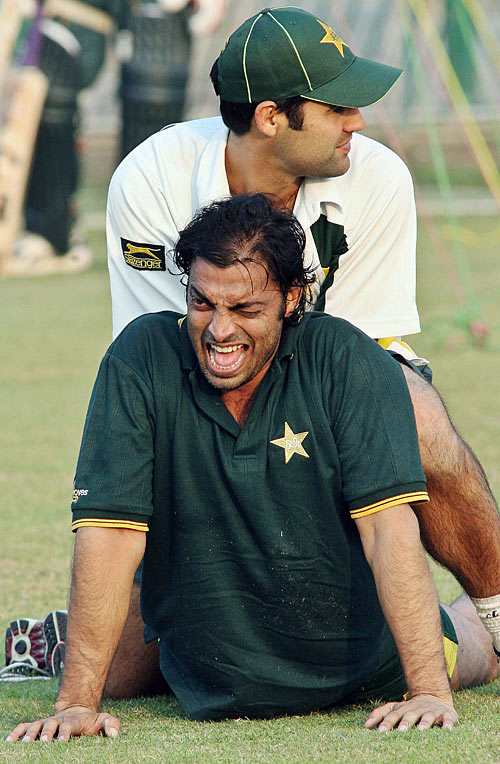
Shoaib: enjoying his return (and by the looks of it, so is Lifson)

Photo credit: AFP

A.Ohhhh!

AI's leaving Philly. My heart is following him right out. Wherever you go, AI, I'm with you, bro. Will write more on this when he's finally traded. I don't want to jinx him by publicly writing on where I want him to end up.

Tuesday, December 05, 2006

Dopegate

I just finished reading the Appeals Committee report so let's get right into this. As always, I'm going to try to break this down into manageable categories.

Justice Fakhruddin G. Ebrahim
Anyone remember this guy? How can you forget? 11 years ago, this same man exonerated Salim Malik on match-fixing and bribery charges, which is kind of like exonerating Nawaz Sharif on charges of being fat or George Bush on charges of being stupid. Now I'm no lawyer (though I did watch The Practice religously for about three seasons and Ally Mcbeal for two), but how was this allowed to happen? How was a guy who was so supremely wrong about most important legal matter in the sport's history allowed to preside over an appeals committee on the second most important legal matter in the sport's history? Shouldn't there be some sort of process by which these committees are chosen? Shouldn't said process include a clause which goes something like "If you thought Salim Malik (Salim Malik!!) was not guilty of match fixing, we have to reason to doubt your intelligence and legal skills and therefore you cannot serve, much less preside over, this committee"? I know I'm not the only one who remember this guy's role in the Salim Malik affair. Why was he picked? Is it because his history suggests a leniency towards Pakistani cricketers? Can someone please clarify this?

The legal issues
Herein lies the crux of the debate. There are three issues to consider here. First, Asif's and Shoaib's defense against the charges. Second, the applicability of ICC/WADA regulations and the difference between them and PCB regulations. Third, the plausiblity and viability of Asif's and Shoaib's version of events. Let's tackle each of these one by one.

Shoaib's defense has three facets to it. One, he was on a high protein diet and had a rigorous workout schedule, a combination which could have caused the positive tests. Two, he was taking numerous over-the-counter nutritional supplements that were not banned and the supplements could have contained nandrolone. Three, he was never warned or told about any anti-doping regulations and so could not have been expected to know about them with any degree of certainty. Remember this paragraph. I'm going to return to it later.

Asif's defense was much simpler, or in the words of the committee "more circumscribed". His basic claim is that he was taking supplements, that he didn't know what they contained and that he discontinued their use immediately when the physiotherapist Darryn Lifson told him to do so.

Let's move on to the PCB vs. the ICC/WADA regulations question. This is one of the two main points on which the justification for the Appeals Committee verdcit rests, so it's important we peruse this carefully. In paragraphs 12 and 13 of the report, the committee says that the first committee (the one that found them guilty and banned them) erroneously used WADA regulations when it should have used the PCB anti-doping code. The matter was under the jurisdiction of the PCB because the tests were conducted internally and not by the sport's governing body, the ICC. As such, "there is no doubt in [their] minds that the PCB Anti Doping Regulations are applicable to the present case of Shoaib Akhtar and Muhammad Asif who were tested in Pakistan by the PCB under its Regulations and not by any other international sports body."

Why does it matter what anti-doping regulations the original committee used? It boils down to the question of whether or not these cases had "exceptional circumstances". According to the Appeals Committee, the regulations on "exceptional circumstances" used by the ICC and the PCB exist on a "significantly different plane". Let's see if that claim is true. Here is the relevant PCB regulation:
Exceptional circumstances exist if...(b)the player held an honest and reasonable belief in a state of facts which, if they existed, would mean that the player did not commit a doping offence.

Here is the relevant ICC regulation:
If the Cricketer establishes in a individual case involving an Anti Doping Code violation under Clause 3.1 (presence of Prohibited Substance or its Metabolites or Markers) or Use of a Prohibited Substance or Prohibited Method under Clause 3.2 that he bears No Fault or Negligence [means that the Cricketer establishing that he did not know or suspect and could not reasonably have known or suspected even with the exercise of utmost caution, that he had Used or been administered the Prohibited Substance or Prohibited Method] for the violation, he shall be found to have committed no violation...

Now, you tell me: do those two regulations exist on a "significantly different plane"? I really don't think so. The only difference I see are the words "utmost caution" in the ICC code which aren't mentioned in the PCB code. This is an important term, but I don't think it's cause for thinking the regulations exist on a "significantly different plane". The PCB regulations seem to say "He's innocent if he didn't know and proves he didn't know." The ICC regulations seem to say "He's innocent if he didn't know despite trying his best to know, and proves both that he didn't know and that he tried his best to know." That's not significantly different.

Where there is a significant difference is where the responsibility lies if a cricketer gets caught. Here's the PCB's code:
The PCB aims to prevent the use of performance enhancing drugs and doping practices in Cricket...by (b) educating and informing persons about drugs in sport issues.

Here's the ICC's code:
It is each Cricket Player's personal duty to ensure that no Prohibited Substance enters his body. Cricket Player's are responsible for any Prohibited Substance or its Metabolites or Markers found to be present in their bodily Specimens. Accordingly, it is not necessary that intent, fault, negligence or knowing Use on the Cricket Player's part be demonstrated in order to establish an anti-doping violation under Clause 3.1.

This is perhaps the most important legal distinction between the ICC's code, largely derived from WADA's, and the PCB's. The ICC is saying "It's the player's responsibility to know what the hell is going on." The PCB is saying "It's our responsibility to make sure the players know what the hell is going on." For the lawyers of Shoaib and Asif, this distinction is half the case. If, given the PCB's own regulations, their lawyers can show that the PCB did not live up to its responsibilities, then its game, set, match. And as we will soon see, showing that the PCB did not live up to its responsibilities isn't particularly difficult (or "taxing" as Rameez Raja might say).

We can now go to the third and final point: the plausibility and viability of Shoaib's and Asif's defense. Let's talk about Shoaib first. His defense, if you remember, was (a) he was on a high protein diet and had a rigorous workout schedule (b) he used over-the-counter supplments that might have contained nandrolone and (c) he was never given any information on the intake of supplements. We can throw (a) out immediately for two reasons. One, there are plenty of other cricketers on high-protein diets who have rigorous workout schedules and none of them test positive for drugs. Two, this defense is not relevant to the central argument his lawyers make, which is that it was the PCB's fault because they didn't supply enough information to the players. On the other hand, (b) and (c) deserve closer scrutiny. There are two questions one needs to ask here. First, if given the number of supplements Shoaib was taking (for the record, they are Blaze Xtreme, Nitron 5, Size On, T-Bomb II, Promax 50 and Viper), is it reasonable to have expected him to ask for information on any of them from the army of trainers and doctors both the PCB and he employ? I say yes. Second, given that Shoaib has been playing international cricket since 1998, has played county cricket (which is run infinitely more professionally than the PCB runs Pakistan cricket) and various ICC tournaments (World Cups, ICCCTs), is it reasonable to expect that he has had more than just one information source, i.e. the PCB, on questions of drugs and supplements? I say yes again. Given that the answers to the previous two questions mean that Shoaib bears at least some responsibility for his failing a drug test, can we say that his ban being reduced to nothing from 24 months is justifiable? I say hell no. Shoaib Akhtar should not be wearing a Pakistan shirt. He should have been banned for at least a year, if not more.

What about Asif? Here's where the incompetence of the PCB is on full display. Asif was not a regular member of the national team until early 2006. In response to the question of how many times the players were made aware of the PCB's anti-doping measures in the last year, the PCB's Anti-Doping Control Officer Dr. Sohail Saleem said "not even once". So how was Asif supposed to know about the dangers of nutritional supplements? Well there's the WADA publication titled "Athlete Guide", which contains warnings on supplements. Did any of our players ever read "Athlete Guide"? Nope. Dr. Sohail Saleem says that when he received the publication, he handed 24 copies to physiotherapist Darryn Lifson. Lifson says he handed the publications to the players, but doesn't remember if Asif and Shoaib were present when he did so. He further says that though drugs and anti-doping measures are his responsibility, nutritional supplements are not. Whose responsibility are they? Trainer Murray Stevenson's he says. Ok, fine. What do you have to say about that, Mr. Stevenson? "I tell players about the diet that they should follow but not about any dietary supplements for which I have no responsibility. I have no responsibility in matters relating to drug and anti drug regulations." Given these farcical statements, I think it's safe to say that Asif bore no responsibility for not knowing what he was taking. Moreover, since even the ICC regulations stipulate that if someone had no idea, then he doesn't deserve any punishment (as opposed to the WADA regulations, which say that under the same circumstances, a punishment can be reduced but not completely striken), we can say the overturning of Asif's ban was justified.

The fall out
Reactions to this entire episode will fall into, broadly speaking, two categories. One will be the Australian/British/Indian media and their supporters, who will say the entire thing was just a ploy, that there was no way in hell Pakistan was going to go to the Caribbean for the World Cup without its two best bowlers, that its typical of us, that we're Paki-cheats and so on. The other will be the "Here we come, Australia, game on!" reaction of the majority of Pakistani fans who're ecstatic that Shoaib and Asif got off and don't care how it happened.

Both reactions are misplaced. I don't think this entire episode was one brilliant conspiracy; that gives way too much credit to the PCB when they're actually a bunch of bumbling idiots who couldn't conspire to kill a cockroach without setting a building on fire. It also is not a case of "typical Pakistan, not punishing its players" because the original punishments were universally deemed as appropriate and I really do think Nasim Ashraf et al were prepared to go to the Windies without Shoaib/Asif to prove a point. Nonetheless, I know very well that we've just bought ourselves at least 12 months worth of unfair coverage from the three major countries because of this. If Asif had been let go but Shoaib punished, with say an 18-month ban and a hefty fine, the world might still have believed us. But from a combined three years down to zero? That just confirms everything they've always thought about us. Can't do anything about it, so no point worrying about it, I guess.

What about the Pakistani fans who are over the moon? I wish I could say I'm as euphoric as them, but I'm not. Treating this as a purely cricketing matter ("our World Cup chances are gone, yaar!") was completely missing the point. I was quite happy with the original bans because it meant we were putting principle over on-the-field results, exactly the reason we garnered so much sympathy when it came to L'affaire Hair. Unfortunately, at least in Shoaib's case, it seems that principles have taken quite a hit here. And for that I'm truly sorry.

What next?
If I'm Shoaib or Asif, I'm going on the internet right now and finding out exactly how long Nandrolone stays in the body. Let's remember the ICC retains the right to test any player at any time in an ICC mandated competition. That means that they can test Shoaib and Asif at the World Cup (or maybe even earlier, I'm not 100% sure about this) in which case the judge, jury and executioner will be ICC people, not PCB people. If that happens, and Nandrolone is found in their systems, you can expect two year bans for them both, because trust me, the ICC is not going to be pleased with this verdict.

What about our team? Well, it's game on, isn't it? Shoaib, Asif, Gully and Dani as an attack on South African pitches? Most captains will take that, I think. So much now depends on whether or not we can put this episode behind us. To that end, and also because someone needs to bear responsibility for this, I want to see heads roll. If the PCB has agreed that Shoaib and Asif are innocent, then by extension that must mean someone else is guilty. I want one of Stevenson or Lifson fired. I want Dr. Sohail Saleem gone. I want accountability. This was a big fucking deal, and for everyone to just go back to their little roles, all hunky-dory, is unacceptable.

Bloody Ridiculous

No details yet, but both Asif and Shoaib have been exonerated. I'm fairly unhappy about this and am going to write more when the exact reasons for this have been laid out. Stay tuned.

Update: My head is spinning right now because (a) this is too much, too quickly and (b) its 2:55 am and I need to sleep. Analysis of this tomorrow, when I wake up.

Mindless Medieval Assholes (or, at the very least, their kin)

Hilarious column by Irfan Hussain, the best of which is reproduced below for your reading pleasure.
While on the subject of fundos, let me share a recent news item that caught my eye. According to a newspaper’s Peshawar correspondent, Maulana Fazlullah has recently advised his FM radio audience not to allow their children to be immunised against polio. Also known as Maulana Radio, he is the son-in-law of Maulana Sufi Mohammad, the head of the Tehrik Nifaz-e-Shariat Mohammadi (TNSM), the outfit that ran the madrassah in Bajaur that was recently flattened by a missile strike. Clearly a man of great stamina, Maulana Radio holds forth for three hours every evening on FM. His reason for this boycott of immunisation teams is blindingly simple. This is how the story quotes him:

“According to Islam and Shariah, people should just stay away from areas which are hit by contagious disease. It is not right to look for a cure before falling ill with a disease.”

Clearly, this should provide consolation to children struck down by polio, as well as to their parents. And I can imagine medical researchers smacking their foreheads when they learn of Maulana Radio’s approach, and exclaiming: “Drat! Now why didn’t I think of that?” But there’s more. The report goes on to quote a regular listener of the programme that, according to Maulana Radio, immunisation shots were a ‘conspiracy by Christians and Jews to make Muslims impotent and stunt the growth of Muslims.’

The maulana also often rails against education for women, and says they should stay at home. And while he uses the radio to great effect, he disapproves very strongly of TV. According to another listener: “The maulana also preaches that if somebody smashes one TV set, his reward would be equivalent to killing two Jews.” Good to know what the going rate for murdering Jews is.

Two Jews! Come on, man, there's no way in hell TV is that bad. I think the converstion rate should be: 2 TVs smashed = 1 Jew killed + 3 women kept home from school + 1 KFC torched. I definitely think that's fairer, though of course with these things, prices are always negotiable.

Never Quiet on the Western Front

I've been meaning to talk about the security situation on the Pakistan-Afghanistan border for a long time now. Thankfully, Fareed Zakaria wrote this column that reminded me that I've been meaning to talk about the security situation on the Pakistan-Afghanistan border for a long time now. As usual, Pakistan is blamed for Afghanistan's troubles.

Afghan President Hamid Karzai and his counterpart in Pakistan, Pervez Musharraf, have openly quarreled about the cause of the Taliban's re-emergence. Musharraf blames Karzai's incompetence and weakness. Karzai argues that Pakistan has been tacitly—and often actively—supporting the Taliban along the Afghanistan-Pakistan border, and in Pakistan itself. Having spoken to a number of senior Western officials and independent observers in both countries, I think it's clear that, in the words of a senior U.S. administration official who wished to remain anonymous because of the sensitivity of the subject, "the weight of the evidence supports President Karzai."

Americans want to believe that all good things go together. But here is a telling example of why that's not always true. President Musharraf is a genuine modernizer who has saved his country from becoming a failed state. Despite the compromises he has had to make, he has been more forward-looking on economics, law, religion and even women's rights issues than any government in Pakistan since the early 1970s. But having confronted Islamic extremists on such matters, Musharraf seems to believe that one area where he need not actively thwart them is in their goal of jihad against Karzai's government and its Western backers.

This attitude is part of a traditional Pakistani world view. The Islamabad strategic elite, which essentially means its top military officers, believes that establishing "strategic depth"—having some sway over events in Afghanistan—is crucial for Pakistan. This mechanistic view comes out of the cold war, when India and Afghanistan tilted toward the Soviet Union, and has gained ground as India and Afghanistan have both become pro-American.

There are even those in Islamabad who believe that to counter these trends, Pakistan should help drive Western forces out of Afghanistan— even establish a pro-Pakistan, Taliban government in Kabul. That would explain Islamabad's constant refrain that the Taliban must be rehabilitated within the Afghan political system.


There are a couple of observations to be made here. First, where is Mr. Zakaria getting his information from? By his own admission, it is "senior Western officials and independent observers in both countries". How impartial are "senior Western officials"? I don't know. I do know three things, though. One, that "senior Western officials" are more likely to support Karzai than Musharraf because Karzai is their guy and he wouldn't be in power if it weren't for the actions of other "senior Western officials". Two, they are likely to be averse to saying anything that might undermine his government at a particularly tenuous time for it when the success of said government is vital to their strategic interests. Three, Pakistan doesn't enjoy a particularly sterling reputation among Western circles (intelligentsia, media, bureaucracies etc). Whether such a reputation is warranted or not is beside the point; the point is if you're a parent and you have two sons and you like one of them more than the other, you're more likely to blame the son you don't like as much for breaking the vase when you weren't home, even if you don't know who did it with anything approaching certainty.

The second observation to be made is the complete lack of context with which Western media presentations of Pakistan-Afghanistan border issues are made. Just once, for my sake if nothing else, I would like the New York Times to mention in one its scathing editorials about how Pakistan "needs to do more" that we have stationed more than 70,000 troops in the region. Just once, I'd like to see an article mention the losses we've had to take in the fight against the Taliban. Perhaps Zakaria could have found space in his column for the fact that less than a month ago, Pakistan lost 42 troops while they were exercising. Surely it wouldn't take that much effort, would it? "On the other hand, Pakistan has 70000 troops in the region and has lost more than 400 soldiers in its fight against the Taliban and its sympathizers over the last few years, including 42 in a vicious attack less than a month ago." See? That wasn't that hard! I know you can go over your word limit by 43 words, Fareed. I know you can. Fuck, you're the editor of the International edition, no one's going to mind if you put in 43 extra words. Come on, Fareed, let's make this happen.

Despite protestation's from a reader and Alien Panda about a disclaimer recently, I'm going to give one more here. None of what I have said precludes the possibility that there are elements within our security apparatus who favour a return of the Taliban's rule in Afghanistan. In other words, I am not disputing the contention that we deserve some of the blame for what the deteriorating security situation in Afghanistan (though I do dispute the contention that support for the Taliban is coming all the way from the top, i.e. Musharraf). I am only decrying the one-sided and patently unfair way in which Pakistan-Afghanistan border issues are dealt with by Western officials and media. In essence my claim is: not everything is our fault, so stop trying to make it sound like it is. Pay attention to the facts. Pay attention to the number of Pakistani troops who've been in the region and who've died. If you have a problem when our government cuts a deal with the Taliban on our side of the border, and want to splash it all over the front page and editorialize about it, fine. But if you're going to do so, then please explain the near defeaning silence with which you greet a similar agreement reached by the Afghan government on their side of the border. If the Afghans themselves are doing it, then perhaps there might be something to the tactic, yes? (I should say for the record that when the agreement was first made, I was strongly against it. I'm still not convinced of its efficacy, but I am less against it now than I was then. For whatever its worth). Blaming Pakistan has been the all-too-easy option for many people lately, whether its the Indian government vis-a-vis the Mumbai train blasts (what happened about that anyway? Oh yeah, the claim was bullshit) or the Karzai government vis-a-vis the security situation on the border. It needs to stop.

Monday, December 04, 2006

Photograph of the day


This picture, showing the execution of 11 Iranians following the revolution in 1979, won the Pulitzer Prize. For a long time, no one knew who took it, and the prize was given to "an unnamed photographer of United Press International". Now, however, the Wall Street Journal has tracked Mr. Jahangir Razmi and his Nikon down. Amazing as the story is, it pales in comparison to the slideshow.

(Link courtesy Andrew Sullivan)

Sunday, December 03, 2006

The Land of the Pure

Great column in Alien Panda's favourite newspaper on how you can get away with anything in Pakistan if you're rich and well connected and nothing if you're not.
The owner of Nirala Sweets is reported to have killed a six-month-old baby and injured the parents while racing his sports car (I am told he was driving a Porsche. Why people would keep Porsches and Hummers in this city is beyond me). He fled from the scene after performing the grand feat and is now reportedly threatening the parents with dire consequences to prevent them from pressing charges against him.

Compare that to
About a week ago, I visited a jail where I met with about two-dozen juvenile inmates, all from poor families. Some might have been guilty, but most were there on charges that boys from affluent families would laugh about. An 11-year-old was under-trial for illicit sexual relations, a charge, which, even if true, should have half the population of Lahore and at least some percentage of the clergy behind bars. Some were being tried on the charge of loitering; some for possession of illegal arms; some on the charge of theft (amounts ranging from Rs1000 to 5000), some for possession of small quantities of cannabis (ask boys and girls at farmhouse parties about that!) and so on.

Since when is possession of cannabis a crime? I'm no "farmhouse" partier, but come on man. Hash is sold on the streets of Peshawar literally like chewing gum. In fact, I'd venture to suggest it's easier to get hash in Peshawar than imported chewing gum. Tell me I'm wrong.

By the way, the story of the guy driving an expensive car killing a baby rang a bell for me. I was racking my brains trying to figure out where I'd heard a story similar to it. Then it hit me: Mohsin Hamid's Moth Smoke, where the protagonist's rich friend runs over a kid in an expensive car (I think it was red) and then the middle class protagonist gets blamed for it and goes to jail (sorry if you were planning on reading it). The only difference is that in the book, the victim was a teenager whereas here it was a 6-month old baby. Pakistan: Where reality trumps fiction.

Winning Hearts and Minds

Don't you just love the American military? Aren't they just the greatest? (Warning: the video may make you puke in disgust).

Saturday, December 02, 2006

On Cricket

Lot's of stuff happening in the cricket world so let's get right to it.

Pakistan 2 - West Indies 0
A fair result? I guess, though you can argue given Asoka's umpiring in the first test and Lara' s innings in the second that the Windies deserved a share of the series. I'm sorry if that comes across as less-than-euphoric, but I really wasn't impressed by our cricket in the series. We dropped an awful lot of catches; our selection was wrong, just wrong (man, was I stupid when I said Razzaq should play); our batting was way too dependent on one guy (will get to him in a second); our bowling lacked bite other than Gully; and Inzi's captaincy, as usual, left a lot to be desired insofar as field placings are concerned. We were lucky that we were playing a fairly crap team, but hey, I'll take it. After the tumultuous events of August-October, I'll definitely take it.

I suppose I should extend fiverupees' heartiest congratulations to Mohammad Yousuf. So, here goes: Congratulations, Mohammad Yousuf. You've made us all very proud. But (drizzle on his parade alert), before we get carried away, let's remember the Windies dropped him something like 6 times in the series. If he was playing Australia, he wouldn't have made one hundred in the series let alone four. And he is also the beneficiary of today's pitches, bats, boundaries and bowling attacks. Consider the fact that 5 of the top 6 and 13 of the top 18 calendar-year aggregates have taken place since 2002. Those are insane numbers.

Look, I (since Lords this year) love Yousuf. Honestly. I really don't want to pull an Ian Bishop/Jeffrey Dujon by downplaying his achievements. 1700 plus runs year in 12 months with nine hundreds is phenomenal, it really is. If anything, "phenomenal" might be putting lightly. And a perfectly reasonable question in response to the "today's pitches are easy and the bowling attacks suck nowadays" argument would be "Ok, why doesn't anyone else score 1700 runs in a year?" That's a legitimate argument, even if it slightly misses the point. The point is not whether or not Yousuf is right up there with the upper tier of this age (Lara, Dravid, Ponting, Tendulkar, in that order). The point I'm trying to make is that we must place Yousuf's achievements in context. Normally I agree with the claim that you can't compare atheletes across different time periods. But here you can. If the list of top run getters is so heavy on post-2002 players, that tells you there's something drastically different today compared with, say, the 80s. So let's chill out and take a deep breath before calling him the best player Pakistan has ever produced as Inzi stupidly put it. He's not even the best player Pakistan has produced currently playing. That player is Inzi.

I'll be very interested to see how Yousuf plays in South Africa. For one thing, he's going to be up against an attack that is completely decimating the Indians right now. For another, the pitches are going to challenge his back foot play as much as any in the world (if SA are smart, they'll prepare Old Trafford 2006 type pitches every time). And for yet another, he's going to be fighting against the law of averages (again). I know I keep harping on that last point, but surely, surely, this run has to end some time. And if it ends in SA, is it because he can't handle their bowling or is because the numbers have finally caught up with him? I for one think that if he does have a poor series, it'll be the latter rather than the former, though of course a lot depends on his mode of dismissals (if he's caught at gully fending off Steyn and Ntini three times in six innings, we'll know it's not the law of averages). Let's wait and see.

Before I move off Pakistan, I want to talk about Imran the Terrible. His flashy, lucky batting has just guaranteed him three tests in South Africa. I've never been good with predictions, but mark my words. Print this post out, underline it, highlight it in pink, yellow and green, do whatever the hell you want. My prediction is this: Imran the Terrible will be a complete, unmitigated disaster in South Africa. I'm talking Agarkar-in-Australia-in-2000 type disaster. I'm talking Atapattu-in-his-debut-series disaster. If he averages more than 15 in South Africa, I promise to write a post with the heading "Ahsan is a complete fucking jackass and doesn't deserve to write about the game and is able to do so only because his friend started a blog". You can hold me to this. I will hold myself to this. 15 is the magic number. Remember this.

Gentleman, the Ashes
I just watched all of day 2 at Adelaide. The first thing that hit me was the difference in commentary (they have three of my four favourites: Mark Nicholas, Ian Chappell and Richie Benaud...they really need to steal David Gower away from Sky). After listening to Haroon Rasheed, Dujon and Rameez it was like going to a Dostoyevsky novel after reading "Archie's Double Digest". The second thing that hit me was, McGrath looks old. I mean really old. The third thing that hit me was that with Collingwood and Pietersen, England have probably the best 4-5 combination in the world at playing spin. They completely took Warne out of the game, treating him like the Indians treat him. I've always said that's the way to play him - so many teams (especially Pakistan) give him way too much respect. If you treat him as a bowler with two variations (leg spinner and slider; his flipper's gone and he never had a googly) he becomes a helluva lot more manageable than you would think. The fourth thing that hit me was that by January, England could well have a legitimate claim to being the best team in the world. I don't say that lightly, and I'm not just swayed by today's play, which was all England. I'm thinking about the way they beat us this summer (yes we were without Shoaib and Asif; but they were without Flintoff, Simon Jones, Anderson and Vaughan). I'm thinking about the way Ian Bell, despite looking completely at sea against Warne yesterday, still did enough to survive and scrap his way to 60, the type of innings every team aspiring to best-in-the-world status needs every now and then. But most of all, I'm thinking about the way they've put Brisbane behind them like it literally never happened. They look at the Aussies as equals - you can tell just the way they play and the stuff they say. And Brisbane did nothing to dispel that notion. I know it sounds horribly cliched, but to be the best, you have to believe you can be/are the best. England do. Which is why they might be in about 5 weeks.

Indian cricket
You know you're in trouble when you're calling Ganguly back to shore your batting up against pace and bounce. Dear God, how did this happen? Less than three years ago, India had a guy averaging more than 50 with a strike rate of 400 as opener (Sehwag), two of the world's three best players (Dravid and Tendulkar), one guy who had the strange habit of being un-dismissable by the best team in the world for anything less than a 100 (Laxman) and a fiery captain whom everyone backed (Ganguly). Less than a year ago, India had largely the same batting lineup, except they substituted one of the world's great young talents (Yuvraj) for the can't bat-can't bowl-can't field ex-captain. In other words, batting really shouldn't have been a problem. But man, what a problem it is. I watched some of the last ODI, and I've never seen a team look so lost against pace. Never. Now Sehwag has lost the vice captaincy, reportedly because of his weight, his work ethic, his attitude, his relationship with Ganguly and his baldness. Dravid's injured, Tendulkar's in crap form, they're using a second keeper as a middle order player and Greg Chappell has overtaken Pervez Musharraf and Daoud Ibrahim for the coveted "most hated man in India" status. All of this convinces me of one thing: India will win the World Cup. Watch it happen.

By the way, the next time any Indian gives you shit about our cricketers being involved in ball-tampering and drugs and doctoring the pitch and whatnot, just respond with the following: at least none of our players has ever killed a man.